Dutch Oven Pork Stew
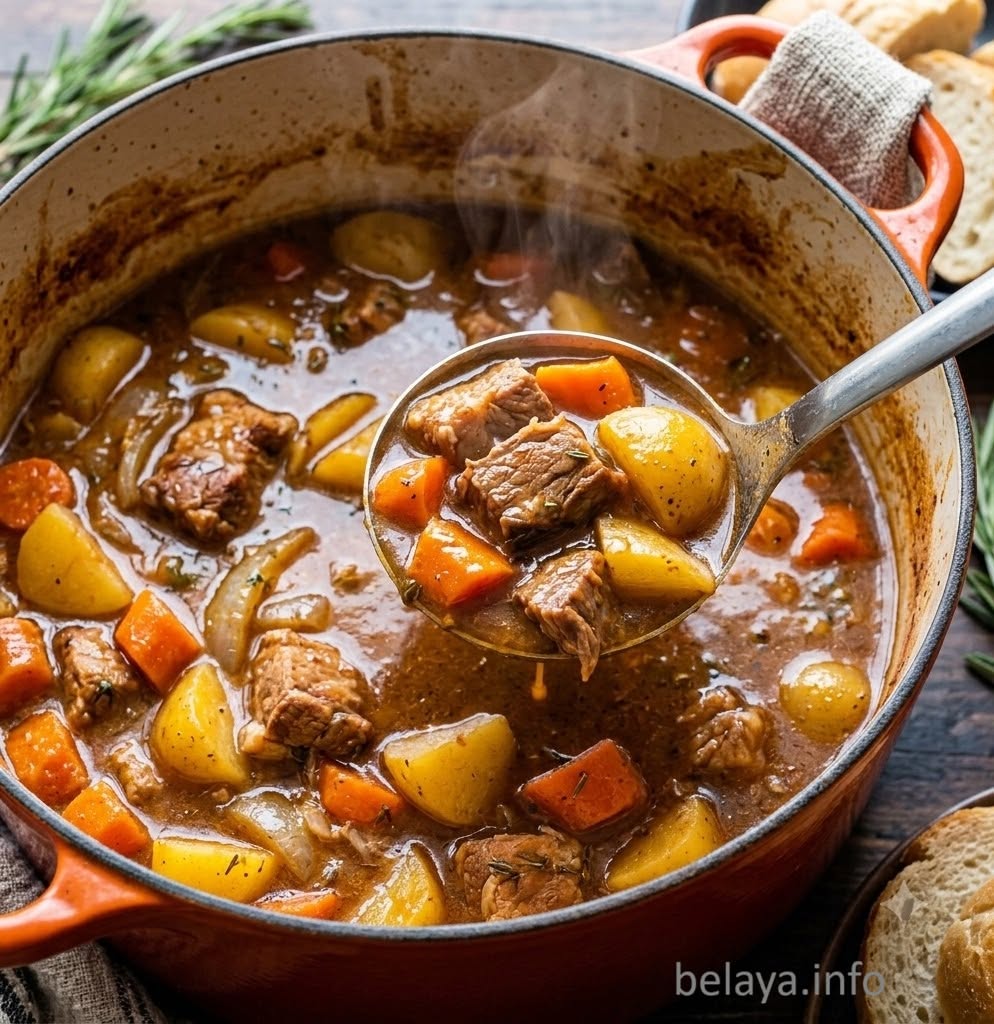
Dutch Oven Pork Stew is a deeply comforting, slow-braised dish built around tender pork shoulder, smoky bacon, potatoes, carrots, parsnips, apple cider, Dijon mustard, herbs, and a rich savory broth. Cooking everything slowly in a heavy Dutch oven allows the pork to become exceptionally tender while the broth develops layers of pork, bacon, tomato, herbs, and gentle apple flavor.
What makes this stew especially interesting is the balance between richness and acidity. Pork butt and bacon provide deep savory flavor, while apple cider, cider vinegar, and Dijon mustard keep the stew from feeling overly heavy. Rosemary, thyme, garlic, and tomato paste create an aromatic background that ties the sweet root vegetables and pork together.
The finished stew should be thick and glossy, with fork-tender pork and vegetables that still hold their shape. It is the kind of one-pot meal that feels especially satisfying during cooler weather and becomes even more flavorful after resting overnight.
Why People Will Love Dutch Oven Pork Stew Recipe
– Pork butt becomes exceptionally tender during slow braising.
– Bacon gives the stew smoky depth.
– Browning the pork creates a richer, more complex broth.
– Apple cider introduces subtle fruitiness without making the stew sweet.
– Apple cider vinegar keeps the rich pork flavor balanced.
– Dijon mustard adds gentle tang and savory complexity.
– Tomato paste deepens the color and umami of the broth.
– Rosemary pairs naturally with pork.
– Thyme adds a subtle earthy herbal note.
– Potatoes absorb the flavorful braising liquid.
– Carrots provide mild sweetness.
– Parsnips bring an earthy, slightly sweet flavor different from ordinary potatoes.
– The Dutch oven method requires relatively little attention once the stew is assembled.
– The meat and vegetables cook in the same pot.
– The broth becomes thick and comforting without using cream.
– Tapioca starch or cornstarch creates a glossy finish.
– It can also be prepared entirely on the stovetop.
– The stew reheats beautifully.
– Leftovers often taste even better the following day.
– It pairs wonderfully with crusty bread, biscuits, or mashed potatoes.
Key Ingredients
Pork Butt:
Pork butt, also called pork shoulder, contains enough fat and connective tissue to become exceptionally tender during long cooking. Its collagen gradually breaks down and gives the broth additional body.
Bacon:
Bacon provides both smoky flavor and cooking fat. Browning the pork in a small amount of rendered bacon fat builds flavor into the stew from the very beginning.
Apple Cider:
Apple cider adds subtle sweetness and fruitiness that naturally complements pork. It also balances the savory broth without making the stew taste like dessert.
Apple Cider Vinegar:
Vinegar provides acidity that cuts through the richness of the pork and bacon.
Dijon Mustard:
Dijon adds tang, mild sharpness, and complexity while blending almost invisibly into the finished broth.
Tomato Paste:
Double-concentrated tomato paste contributes umami, color, and a slightly caramelized depth when cooked briefly with the aromatics.
Baby Potatoes:
Potatoes absorb the broth while maintaining enough structure to remain intact during the long cooking process.
Carrots and Parsnips:
These root vegetables provide sweetness, earthiness, and texture while complementing the apple and herb flavors.
Rosemary and Thyme:
These dried herbs give the stew its warm, rustic aroma and work particularly well with pork and root vegetables.
Expert Tips
– Choose pork shoulder with some visible marbling for the most tender result.
– Cut the pork into similarly sized pieces so they cook evenly.
– Pat the meat dry before seasoning and browning.
– Brown the pork in batches instead of crowding the Dutch oven.
– Let the pork sit against the hot surface long enough to develop color before turning it.
– Save the browned bits on the bottom of the pot; they contain tremendous flavor.
– Deglaze thoroughly with chicken broth.
– Cook the tomato paste briefly before adding liquid to deepen its flavor.
– Use unsweetened or minimally sweetened apple cider if available.
– Keep the braising temperature low and gentle.
– Judge the pork by tenderness rather than cooking time alone.
– Add the vegetables later so they do not disintegrate while the pork braises.
– Cut carrots and parsnips fairly thick.
– Leave very small baby potatoes whole if desired.
– Mix starch only with cold water before adding it to the hot stew.
– Add the slurry gradually because the broth can thicken quickly.
– If using cornstarch, bring the stew to a gentle simmer after adding it for full thickening.
– Remove the bay leaves before serving.
– Let the finished stew rest before eating so the sauce settles and thickens slightly.
Dutch Oven Pork Stew
Ingredients
For the Pork and Bacon
– 4 slices bacon, cut into ½-inch pieces
– 2½–3 pounds pork butt, cut into 1½-inch cubes
– 1 teaspoon kosher salt, divided
– ¾ teaspoon freshly ground black pepper, divided
For the Aromatic Base
– 1 cup yellow onion, diced
– 3 garlic cloves, minced
– 2 tablespoons double-concentrated tomato paste
– ½ teaspoon dried thyme
– ½ teaspoon dried rosemary
For the Braising Liquid
– 3 cups gluten-free chicken broth
– 1 cup apple cider
– 2 tablespoons apple cider vinegar
– 2 tablespoons Dijon mustard
– 2 bay leaves
For the Vegetables
– 1 pound baby potatoes, cut into bite-sized pieces
– 1 cup carrots, cut into thick slices
– 1 cup parsnips, cut into thick slices
For Thickening the Stew
– ¼ cup tapioca starch or cornstarch
– 3 tablespoons cold water
Instructions
Preheat the Oven
Preheat the oven to 300°F / 149°C.
Cook the Bacon
Place the chopped bacon in a large Dutch oven over medium heat.
Cook until crisp, then transfer the bacon to a paper towel-lined plate.
Pour off the excess bacon fat, leaving about 2 tablespoons in the pot.
Season and Brown the Pork
Season the pork cubes with ½ teaspoon salt and ¼ teaspoon black pepper.
Working in batches, add the pork to the hot Dutch oven without overcrowding the pot.
Brown the pork well on two sides. The meat does not need to cook through at this stage.
Transfer the browned pork to a plate and loosely cover with foil.
Sauté the Onion
Add the diced onion to the same Dutch oven.
If the pot seems dry, add a small amount of oil.
Cook for about 5 minutes, stirring occasionally, until the onion is softened.
Add the Aromatics and Seasonings
Stir in the minced garlic, tomato paste, dried thyme, dried rosemary, and the remaining salt and black pepper.
Cook for about 1 minute, stirring constantly, until fragrant and well combined.
Deglaze the Pot
Pour in ½ cup of the chicken broth.
Use a wooden spoon or spatula to scrape up the browned bits from the bottom of the Dutch oven.
Build the Stew
Return the browned pork and crispy bacon to the pot along with any accumulated pork juices.
In a bowl, whisk together the remaining chicken broth, apple cider, apple cider vinegar, and Dijon mustard.
Pour the mixture into the Dutch oven.
Add the bay leaves and stir gently.
Braise the Pork
Cover the Dutch oven with a lid.
Transfer it to the preheated oven and cook for 1½–2 hours, until the pork is beginning to become tender.
Add the Vegetables
Carefully remove the Dutch oven from the oven.
Add the baby potatoes, carrots, and parsnips.
Stir gently, cover again, and return the pot to the oven.
Cook for approximately 1 additional hour, or until the vegetables are fork-tender and the pork is very tender.
Thicken the Stew
Remove the Dutch oven from the oven.
In a small bowl, stir together the tapioca starch or cornstarch and cold water until completely smooth.
Slowly pour the slurry into the hot stew while stirring.
The stew should begin to thicken quickly.
If it remains too thin, place the Dutch oven over medium heat on the stovetop and simmer gently, stirring, until the broth reaches your desired consistency.
Remove and discard the bay leaves before serving.
Rest and Serve
Let the stew rest for about 5–10 minutes before serving.
Taste and adjust the salt and black pepper if needed.
Serve hot with crusty bread, biscuits, or your favorite side.
Stovetop Method
After returning the browned pork and bacon to the pot and adding the broth mixture and bay leaves, bring the stew to a gentle simmer over medium heat.
Cover the Dutch oven and reduce the heat to medium-low.
Cook for approximately 60–90 minutes, stirring occasionally, until the pork begins to soften.
Add the potatoes, carrots, and parsnips.
Cover and continue cooking for about 30 minutes, or until the vegetables and pork are fork-tender.
Prepare and stir in the starch slurry as described above.
Continue simmering until the stew thickens.
Because more liquid evaporates during stovetop cooking, add up to 1 additional cup chicken broth if needed, or reduce the thickener to about 3 tablespoons starch for a looser consistency.
Important Notes When Making Dutch Oven Pork Stew
– Pork shoulder benefits from long cooking even after it has reached a safe internal temperature.
– The pork is ready when it is fork-tender and easily separates, not merely when it is technically cooked.
– Bacon and chicken broth may already contain substantial sodium.
– Dijon mustard also adds some sodium.
– Taste before adding additional salt at the end.
– Do not use apple cider vinegar as a direct substitute for the full cup of apple cider; they serve very different purposes.
– The apple flavor should remain subtle in the finished stew.
– Potatoes, carrots, and parsnips should be added only after the pork has had time to tenderize.
– The starch slurry should always be smooth before adding it.
– Never add dry cornstarch directly to the stew because it can form lumps.
– Tapioca starch can produce a slightly glossier sauce than cornstarch.
– The stew continues to thicken as it cools.
– Add a splash of broth when reheating if necessary.
– Stovetop cooking usually causes more evaporation than oven braising.
– Refrigerate leftovers promptly after cooling.
How to Enjoy Dutch Oven Pork Stew After Cooking
Let the stew rest for approximately 5–10 minutes after thickening. This allows the broth to settle and gives the flavors a chance to become more cohesive.
Serve it very hot in deep bowls, making sure each serving includes pork, potatoes, carrots, parsnips, bacon, and plenty of sauce.
Crusty bread is one of the best accompaniments because it can absorb the rich cider-Dijon broth.
Warm biscuits are another excellent choice, especially if you prefer a softer, buttery side.
For an even heartier meal, spoon the stew over mashed potatoes or creamy polenta.
A crisp green salad with a tart vinaigrette provides a fresh contrast to the rich pork.
Fresh parsley can be scattered over the top just before serving for color and freshness.
A small amount of Dijon mustard can also be served at the table for anyone who wants a sharper finish.
When enjoying leftovers, reheat slowly over medium-low heat and add a splash of chicken broth if the sauce has become too thick.
Nutrition Information
Approximate nutrition per serving, based on 8 servings and using approximately 2¾ pounds of pork butt:
Calories: 510 kcal | Total Fat: 30 g | Saturated Fat: 10 g | Monounsaturated Fat: 13 g | Polyunsaturated Fat: 3 g | Cholesterol: 105–120 mg | Sodium: 750–1,000 mg depending on the bacon, chicken broth, Dijon mustard, and added salt | Total Carbohydrates: 24 g | Dietary Fiber: 3.5 g | Sugars: 7 g | Protein: 34–37 g
Additional estimate:
Potassium: 950–1,150 mg | Calcium: 55–80 mg | Iron: 2.5–3.5 mg | Magnesium: 50–70 mg | Vitamin A: 4,500–6,000 IU | Vitamin C: 12–20 mg | Vitamin B12: 1.2–1.8 mcg | Zinc: 4–5.5 mg
Frequently Asked Questions:
What does Dutch Oven Pork Stew taste like?
It is savory, smoky, slightly tangy, and gently sweet, with tender pork, earthy herbs, root vegetables, and subtle apple flavor in the background.
Does the stew taste strongly like apple?
No. The cider adds mild fruitiness and sweetness, but pork, bacon, mustard, herbs, and broth remain the dominant flavors.
Why use pork butt instead of pork loin?
Pork butt contains more fat and connective tissue, which makes it much better suited to several hours of slow braising. Pork loin can become dry during such long cooking.
What should I serve with Dutch Oven Pork Stew?
Crusty bread, biscuits, mashed potatoes, polenta, or a simple green salad all pair very well.
Is the stew better the next day?
Often yes. Refrigerating it overnight allows the herbs, cider, mustard, pork, and vegetables to develop a more integrated flavor.
Why is my pork still tough after two hours?
The pork likely needs more time. Tough shoulder meat becomes tender only after its connective tissue has had enough time to break down. Continue braising gently until it is fork-tender.
Why should I brown the pork before braising it?
Browning creates caramelized flavors that cannot be developed by simply boiling the pork in broth. Those browned bits also enrich the stew when the pot is deglazed.
Why are the vegetables added later?
Pork shoulder needs considerably longer to tenderize than potatoes, carrots, and parsnips. Adding the vegetables later prevents them from becoming mushy.
What should I do if the finished stew is too thick?
Stir in warm chicken broth a little at a time until it reaches your preferred consistency.
What should I do if the stew is still too thin after adding the slurry?
Bring it to a gentle simmer on the stovetop and stir for several minutes. If necessary, prepare a small additional slurry rather than adding dry starch directly.