Eggplant Parmesan with Spaghetti
Eggplant Parmesan with Spaghetti is a classic Italian-American comfort meal that combines golden breaded eggplant, rich marinara sauce, melted mozzarella, savory Parmesan or Romano cheese, fresh herbs, and a generous serving of spaghetti. It brings together crispy, creamy, cheesy, and saucy textures on the same plate.
The eggplant is first breaded and fried until golden, giving each slice a flavorful crust while keeping the center soft and tender. Once layered with marinara and cheese, those crisp slices gradually absorb some of the tomato sauce during baking, creating the characteristic soft-but-structured texture of a great Eggplant Parmesan.
Serving it alongside spaghetti makes the dish feel especially complete. The pasta carries more of the tomato sauce while the baked eggplant provides richness and texture, creating the kind of satisfying meal that works beautifully for Sunday dinner, family gatherings, or whenever you want traditional Italian-American comfort food.
Why People Will Love Eggplant Parmesan with Spaghetti Recipe
The eggplant develops a crisp, golden breadcrumb coating before baking.
The inside of each eggplant slice becomes soft and almost creamy.
Mozzarella creates rich, stretchy layers between the eggplant.
Parmesan or Romano adds a sharper, savory cheese flavor.
Marinara sauce brings acidity that balances the fried eggplant and cheese.
Fresh parsley adds color and a subtle herbal freshness.
The layered casserole gives you sauce, cheese, and eggplant in every bite.
Spaghetti turns the Eggplant Parmesan into a complete, satisfying dinner.
The pasta provides an extra way to enjoy the rich marinara sauce.
Browning the eggplant before baking creates much more flavor than simply baking raw slices.
The crispy edges contrast beautifully with the soft inner layers.
The recipe is completely meat-free while still feeling substantial.
It works well for family dinners and larger gatherings.
It can be assembled ahead of time.
The dish reheats very well.
Homemade or good-quality jarred marinara can both be used.
The cheese amounts can easily be adjusted to personal preference.
It pairs naturally with garlic bread and salad.
The finished casserole looks impressive without difficult decorating.
Leftovers often taste even richer after the sauce has had time to settle into the layers.
Key Ingredients
Eggplant:
Eggplant is the centerpiece of the dish. Once fried, its interior becomes creamy and tender while the breadcrumb coating provides enough structure to hold up beneath the sauce and cheese.
Italian-Style Breadcrumbs:
Breadcrumbs create the crisp exterior that distinguishes Eggplant Parmesan from a simple baked eggplant casserole. Seasoned breadcrumbs also introduce herbs and additional flavor.
Eggs:
The egg wash helps the breadcrumb coating adhere firmly to each eggplant slice and gives the crust a richer texture.
Mozzarella Cheese:
Mozzarella provides the creamy, stretchy cheese layers that make the casserole rich and comforting.
Parmesan or Romano Cheese:
These hard aged cheeses add saltiness, nuttiness, and umami. Romano provides a sharper, saltier flavor, while Parmesan is slightly milder and nuttier.
Marinara Sauce:
Marinara connects every component of the meal. Its acidity balances the fried eggplant and cheese while also coating the spaghetti.
Olive Oil:
Olive oil gives the fried eggplant a richer Mediterranean flavor and helps develop its crisp, golden crust.
Spaghetti:
Spaghetti creates the classic Italian-American side for Eggplant Parmesan and provides a simple base for additional tomato sauce and grated cheese.
Expert Tips
Choose firm, glossy eggplants without soft spots.
Slice the eggplant evenly so every piece cooks at approximately the same rate.
Keep slices around ¼ inch thick for a good balance between crisp coating and tender center.
Lightly salting the eggplant before breading can help remove excess moisture.
Pat the slices thoroughly dry after salting.
Do not skip drying, because wet eggplant makes the breading less crisp.
Press breadcrumbs gently onto each slice so the coating adheres well.
Let breaded eggplant rest for several minutes before frying if time allows.
Keep the oil hot enough to fry rather than soak into the breading.
Fry in batches and avoid overcrowding the skillet.
Add more oil between batches only as needed.
Transfer fried slices to a wire rack for better crispness.
Use paper towels if a wire rack is unavailable.
Do not drown every layer in marinara.
A moderate amount of sauce preserves more texture.
Drain fresh mozzarella if using it instead of low-moisture mozzarella.
Spread cheese evenly across each layer.
Finish with cheese on top for attractive browning.
Let the casserole rest before cutting.
Cook spaghetti only to al dente.
Reserve pasta water before draining.
Toss pasta with sauce rather than simply pouring sauce over dry noodles.
Reheat leftovers in the oven when possible to restore some texture.
Eggplant Parmesan with Spaghetti
Ingredients
For the Eggplant Parmesan
2 large eggplants
3 large eggs
2 tablespoons milk or water
2 cups Italian-style breadcrumbs
½ cup finely grated Parmesan or Romano cheese, divided
½ teaspoon salt
¼ teaspoon freshly ground black pepper
Olive oil, as needed for frying
3 cups marinara sauce, divided
2½ cups shredded or sliced mozzarella cheese
¼ cup fresh parsley, finely chopped
For the Spaghetti
12 ounces spaghetti
2 cups marinara sauce
Salt, for the pasta water
Grated Parmesan or Romano cheese, for serving
Fresh parsley, optional
Instructions
Prepare the Eggplant
Peel the eggplants and slice them crosswise into approximately ¼-inch-thick rounds.
Arrange the slices in a single layer and lightly season with salt.
Let them rest for about 20–30 minutes if desired to draw out excess moisture.
Pat the eggplant completely dry with paper towels before breading.
Prepare the Breading Station
In a shallow bowl, whisk together the eggs and milk or water.
In a second shallow dish, combine the breadcrumbs with about ¼ cup grated Parmesan or Romano cheese, black pepper, and a small pinch of salt.
Dip each eggplant slice into the egg mixture, allowing the excess to drip off.
Coat both sides thoroughly with breadcrumbs, pressing gently so the coating adheres.
Fry the Eggplant
Pour enough olive oil into a large skillet to create a shallow layer and heat over medium to medium-high heat.
Working in batches, add the breaded eggplant without overcrowding the skillet.
Fry for approximately 2–3 minutes per side, or until golden brown and tender.
Transfer the fried slices to a paper towel-lined plate or wire rack to drain excess oil.
Repeat with the remaining eggplant, adding more oil as needed.
Prepare the Baking Dish
Preheat the oven to 400°F / 200°C.
Spread a thin layer of marinara sauce across the bottom of a 9 × 13-inch baking dish.
Build the First Layer
Arrange a layer of fried eggplant over the sauce.
Spoon a small amount of marinara over the eggplant.
Add a layer of mozzarella cheese.
Sprinkle with grated Parmesan or Romano cheese and a little chopped parsley.
Continue Layering
Repeat the same sequence:
- Eggplant
- Marinara sauce
- Mozzarella
- Grated cheese
- Parsley
Continue until you have approximately 4 layers, or until all of the eggplant has been used.
Finish the top with marinara, mozzarella, and grated cheese.
Bake
Place the baking dish uncovered in the preheated oven.
Bake for approximately 25–30 minutes, or until the sauce is bubbling and the mozzarella is fully melted with lightly browned spots.
Rest
Remove the Eggplant Parmesan from the oven and allow it to rest for about 5–10 minutes.
This helps the layers settle and makes the dish easier to slice.
Cook the Spaghetti
While the Eggplant Parmesan is baking, bring a large pot of generously salted water to a boil.
Add the spaghetti and cook until al dente, following the package directions.
Reserve about ½ cup pasta water, then drain.
Sauce the Pasta
Warm about 2 cups marinara sauce in a large skillet or saucepan.
Add the drained spaghetti and toss until evenly coated.
If necessary, add a small splash of reserved pasta water to loosen the sauce.
Serve
Place a portion of spaghetti on each plate.
Spoon additional marinara over the pasta and finish with grated Parmesan or Romano cheese.
Place a generous square or stack of Eggplant Parmesan alongside the spaghetti.
Spoon a little extra marinara around the plate and finish with fresh parsley.
What the Finished Dish Should Be Like
The finished Eggplant Parmesan should have soft, tender eggplant beneath a flavorful breadcrumb coating, layers of melted mozzarella, rich marinara sauce, and salty grated cheese.
The outside edges should have a little crispness, while the inner layers become soft and almost creamy from the sauce and melted cheese.
The spaghetti should remain al dente and lightly coated with marinara rather than swimming in sauce.
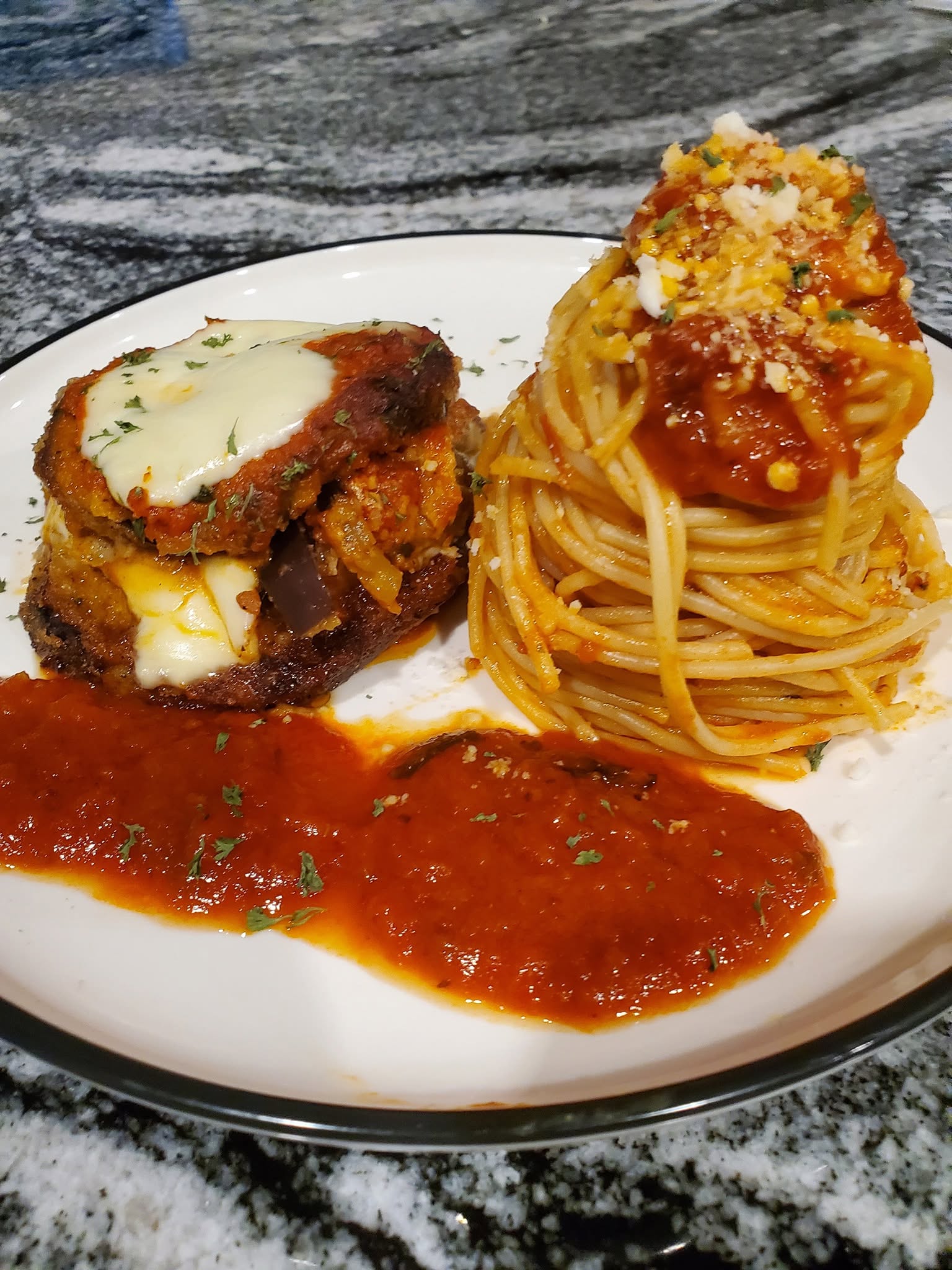
Together, the two components create the classic Italian-American combination shown in the photo: crispy and cheesy eggplant on one side, tomato-coated spaghetti on the other, with plenty of marinara and grated cheese to bring everything together.
Important Notes When Making Eggplant Parmesan with Spaghetti
Eggplant absorbs oil easily, so frying temperature is important.
Oil that is too cool produces greasy eggplant.
Oil that is excessively hot can burn the breadcrumbs before the eggplant softens.
Salting eggplant is helpful but not absolutely required with many modern varieties.
The casserole will naturally become softer during baking.
Eggplant Parmesan is not supposed to stay completely crispy after being layered with sauce.
Too much marinara can make the casserole watery.
Very wet mozzarella can also release excess liquid.
Let the baked dish rest for 5–10 minutes before slicing.
Resting makes the layers more stable.
Parmesan and Romano can both be salty, so season the breadcrumb mixture carefully.
Jarred marinara varies substantially in sodium and sugar.
Angel hair or another pasta can replace spaghetti if desired.
Fried eggplant can be prepared earlier in the day and refrigerated before assembly.
Cooked Eggplant Parmesan should be refrigerated promptly after serving.
Bread, extra cheese, and larger pasta portions can increase the calories considerably.
How to Enjoy Eggplant Parmesan with Spaghetti After Cooking
Allow the Eggplant Parmesan to rest for about 5–10 minutes after removing it from the oven. This gives the melted cheese and sauce time to settle so the layers stay together better when cut.
Place a portion of hot spaghetti onto each plate first.
Spoon marinara over the spaghetti, then finish with a little grated Parmesan or Romano cheese.
Place a square or layered portion of Eggplant Parmesan next to the pasta.
Spoon a small amount of additional marinara around the eggplant rather than completely covering the crispy edges.
Finish the plate with chopped fresh parsley or basil.
For additional richness, add a small amount of freshly grated cheese immediately before serving.
Crushed red pepper flakes are excellent for anyone who prefers a spicy tomato sauce.
Serve with garlic bread or crusty Italian bread to soak up the remaining marinara.
A simple green salad dressed with lemon juice or red wine vinegar provides a refreshing contrast to the fried eggplant and melted cheese.
For leftovers, reheat Eggplant Parmesan in a moderate oven until hot. Reheat the spaghetti separately with a small spoonful of marinara so it does not dry out.
Nutrition Information
Approximate nutrition is based on 6 generous servings, including both the Eggplant Parmesan and spaghetti. The estimate assumes moderate olive-oil absorption during frying and does not include garlic bread or extra cheese added at the table.
Calories: 780 kcal | Total Fat: 32 g | Saturated Fat: 11 g | Monounsaturated Fat: 14 g | Polyunsaturated Fat: 4 g | Cholesterol: 125–145 mg | Sodium: 1,300–1,700 mg depending on the marinara, breadcrumbs, mozzarella, Parmesan or Romano, and added salt | Total Carbohydrates: 91–96 g | Dietary Fiber: 10–12 g | Sugars: 16–20 g | Protein: 28–32 g
Additional estimate:
Potassium: 1,050–1,300 mg | Calcium: 450–550 mg | Iron: 4.5–6 mg | Magnesium: 80–105 mg | Vitamin A: 1,300–1,800 IU | Vitamin C: 15–25 mg | Vitamin B12: 1–1.5 mcg | Folate: 130–180 mcg | Phosphorus: 450–550 mg
Frequently Asked Questions:
What does Eggplant Parmesan taste like?
It is savory, cheesy, tomato-rich, and slightly sweet, with tender eggplant surrounded by seasoned breadcrumbs, melted mozzarella, and aged cheese.
Why serve spaghetti with Eggplant Parmesan?
Spaghetti provides a simple way to enjoy additional marinara and turns the baked eggplant into a more substantial, complete meal.
Is Eggplant Parmesan vegetarian?
This version is meat-free, but check the cheeses if strict vegetarian preparation matters because some traditional Parmesan-style cheeses use animal-derived rennet.
What should I serve with Eggplant Parmesan and spaghetti?
A green salad, garlic bread, roasted vegetables, sautéed spinach, or broccoli all work especially well.
Can I use another cheese instead of mozzarella?
Yes. Provolone, fontina, or a mozzarella-provolone blend can work, although mozzarella gives the most classic creamy, stretchy result.
Why did my Eggplant Parmesan become watery?
The eggplant, mozzarella, or marinara may have contained too much moisture. Pat eggplant dry, drain wet cheese thoroughly, and avoid using excessive sauce.
Why is my fried eggplant greasy?
The oil was probably not hot enough, or too many slices were added at once. Fry in small batches over steady medium to medium-high heat.
Can I bake the breaded eggplant instead of frying it?
Yes. Lightly coat the breaded slices with oil and bake until golden, flipping once. The result will be lighter but somewhat less rich and crisp than fried eggplant.
Can I assemble Eggplant Parmesan ahead of time?
Yes. You can assemble it several hours ahead and refrigerate it covered. Allow slightly more baking time if it goes into the oven cold.
How do I keep the layers from falling apart when serving?
Use a moderate amount of sauce, bake until the center is hot and bubbling, and allow the casserole to rest for at least 5–10 minutes before slicing.