Jalapeno Salt
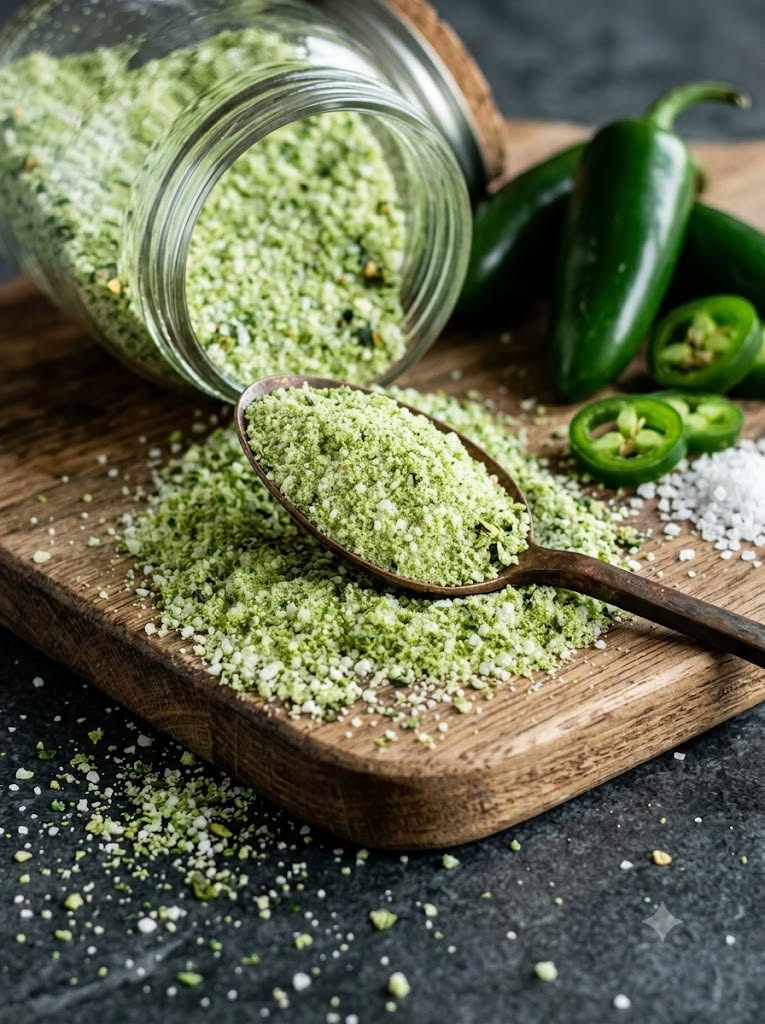
Jalapeño Salt is a simple but intensely flavorful seasoning that combines fully dehydrated jalapeños with coarse kosher salt. As the peppers dry, their moisture disappears while their green, earthy, and gently smoky chile character becomes concentrated, giving ordinary salt a noticeably deeper personality.
What makes this seasoning especially useful is its versatility. A small pinch can bring both salt and chile flavor to eggs, grilled meats, vegetables, potatoes, corn, avocado, tacos, popcorn, and even the rim of a citrus drink. Instead of adding salt and chile separately, Jalapeño Salt delivers both in one step.
The texture can also be customized. Keep it coarse for finishing dishes where visible jalapeño pieces are desirable, or process it more finely for an evenly distributed everyday seasoning.
Why People Will Love Jalapeno Salt Recipe
– It requires only two basic ingredients.
– Fresh jalapeños develop a more concentrated flavor after dehydration.
– It adds heat and seasoning at the same time.
– The spice level is noticeable without necessarily overwhelming food.
– Every batch has a slightly different natural jalapeño character.
– The recipe is an excellent way to preserve extra fresh jalapeños.
– It requires very little hands-on preparation.
– The dehydrator does most of the work.
– The texture can be coarse or finely ground.
– Coarse pieces make an attractive finishing salt.
– Fine jalapeño salt distributes evenly over food.
– It works with Mexican, Southwestern, grilled, and everyday dishes.
– It is especially good with foods that already pair well with fresh jalapeños.
– It contains no artificial chile flavoring.
– You control the ratio of pepper to salt.
– It can be made hotter by leaving more membrane in the peppers.
– It makes a useful homemade seasoning for meal prep.
– A small amount delivers plenty of flavor.
– Properly dried jalapeños store much more conveniently than fresh peppers.
– It can replace plain salt in many savory recipes.
Key Ingredients
Dehydrated Jalapeños:
The jalapeños provide the heat, green chile flavor, and subtle vegetal sweetness. Removing moisture concentrates their flavor and allows them to blend with salt without introducing excess water.
Coarse Kosher Salt:
Kosher salt acts as both seasoning and carrier for the dried jalapeño. Its coarse crystals also make it easy to control the final texture in a food processor.
Expert Tips
– Choose firm, fresh jalapeños without soft spots.
– Wear gloves when cutting a large quantity of peppers, especially if your skin is sensitive.
– Cut the jalapeños into relatively uniform pieces so they dry at the same rate.
– Arrange them in a single layer on dehydrator trays.
– Do not overlap the pieces heavily.
– Rotate trays if your dehydrator has noticeable hot and cool zones.
– Dry until the jalapeño pieces are completely brittle, not merely leathery.
– Break a cooled piece in half to test dryness; it should snap rather than bend.
– Allow the dehydrated peppers to cool before judging their final texture.
– Measure the jalapeños only after they are fully dehydrated.
– Pulse the peppers briefly before adding salt if you want visible chile pieces.
– Process everything together longer for a finer seasoning.
– Use short pulses rather than continuously running the processor so you can control texture.
– Let dust settle inside the food processor for a few seconds before opening it.
– Avoid inhaling finely ground jalapeño particles.
– Make sure the storage jar is completely clean and dry.
– Use a dry spoon every time you remove seasoning.
– Keep the container away from steam near the stove.
– Label the jar with the preparation date.
– Make smaller batches if you want the freshest possible jalapeño aroma.
Jalapeño Salt
Ingredients
– ½ cup fully dehydrated jalapeño pieces, prepared from about 10 fresh jalapeños
– 1 cup coarse kosher salt
Instructions
Dehydrate the Jalapeños
Wash the fresh jalapeños thoroughly, then dice them into small pieces.
Spread the chopped jalapeños in a single layer on the trays of a food dehydrator.
Dehydrate at 125°F / 52°C for about 6–10 hours, or until the pieces are completely dry and brittle with no remaining moisture.
Break Up the Dried Jalapeños
Measure ½ cup dehydrated jalapeños and place them in a food processor.
Pulse 2–3 times to break them into smaller pieces.
If you prefer a very fine jalapeño salt, you can skip this step and process everything together with the salt.
Add the Salt
Add 1 cup coarse kosher salt to the food processor.
Blend to Your Preferred Texture
Pulse until the jalapeños and salt are evenly combined.
For a coarser seasoning, pulse only a few times.
For a finer jalapeño salt, continue processing until the mixture reaches your desired consistency.
Store
Transfer the finished jalapeño salt to a clean, completely dry airtight container.
Store in a cool, dry place and transfer to a salt shaker or small seasoning bowl as needed.
Make sure the jalapeños are fully dehydrated before mixing with the salt to help prevent clumping or spoilage.
Important Notes When Making Jalapeno Salt
– The jalapeños must be completely dehydrated before being mixed with the salt.
– Any remaining moisture can encourage clumping and shorten storage quality.
– Drying time varies depending on pepper thickness, humidity, dehydrator airflow, and how finely the jalapeños are cut.
– The stated 6–10 hours is therefore a guideline rather than an absolute endpoint.
– Always judge doneness by dryness and brittleness.
– Jalapeño heat varies naturally from pepper to pepper.
– Much of a chile’s capsaicin is concentrated in the pale inner membranes.
– Removing membranes before dehydration produces a milder seasoning.
– Kosher salt brands differ dramatically in crystal size and sodium by volume.
– Measure seasoning conservatively until you know how salty your particular batch tastes.
– Finely processed salt tastes more evenly salty because it disperses quickly across food.
– Keep moisture, wet utensils, and steam away from the finished mixture.
– If the mixture ever develops visible moisture, mold, or an unusual odor, discard it.
– Store it in a cool, dry place away from direct heat and sunlight.
– For the strongest jalapeño aroma, use it within several months rather than keeping it indefinitely.
How to Enjoy Jalapeño Salt After Making
Use Jalapeño Salt anywhere you would normally reach for ordinary salt but want an extra layer of chile flavor.
Sprinkle a small amount over scrambled, fried, or poached eggs immediately before serving.
Use it on roasted or grilled potatoes, French fries, sweet potato fries, or hash browns.
It is excellent sprinkled over grilled chicken, steak, pork, shrimp, or fish after cooking.
Add a pinch to avocado toast or fresh guacamole for simultaneous salt and chile flavor.
Sprinkle it over corn on the cob with lime juice and a little butter or crema.
Use it on roasted vegetables such as zucchini, cauliflower, broccoli, asparagus, or bell peppers.
For snacks, try it over popcorn, roasted nuts, tortilla chips, or homemade potato chips.
It also makes an excellent rim seasoning for margarita-style mocktails, citrus sparkling drinks, or tomato-based beverages. Because the seasoning is salty, use only a thin coating on the rim.
When cooking with it rather than using it as a finishing salt, start with a small amount and taste before adding more.
Nutrition Information
Approximate nutrition is based on a ¼-teaspoon serving. Because kosher salt brands have very different crystal sizes and sodium levels, sodium is given as a range.
Calories: 0–2 kcal | Total Fat: 0 g | Saturated Fat: 0 g | Monounsaturated Fat: 0 g | Polyunsaturated Fat: 0 g | Cholesterol: 0 mg | Sodium: 400–550 mg depending on the kosher salt brand and jalapeño-to-salt ratio | Total Carbohydrates: 0.2 g | Dietary Fiber: 0.1 g | Sugars: 0.1 g | Protein: 0.1 g
Additional estimate:
Potassium: 5–15 mg | Calcium: 1–3 mg | Iron: 0–0.1 mg | Magnesium: 1–2 mg | Vitamin C: trace amounts after dehydration | Vitamin A: 20–50 IU
Frequently Asked Questions:
What does Jalapeño Salt taste like?
It tastes salty first, followed by concentrated green jalapeño flavor and a mild-to-moderate chile heat that develops as you eat.
Is Jalapeño Salt extremely spicy?
Usually not, but heat varies considerably between jalapeños. Leaving the inner membranes intact creates a hotter seasoning.
What foods work best with Jalapeño Salt?
Eggs, grilled meats, seafood, potatoes, corn, avocado, roasted vegetables, popcorn, fries, tacos, and citrus drinks are especially good choices.
Is this the same as mixing fresh jalapeños with salt?
No. Fresh peppers contain too much water for this type of dry seasoning. Dehydration concentrates the flavor and allows the mixture to remain dry.
Can Jalapeño Salt replace regular salt in recipes?
Yes, in many savory dishes. However, start with a smaller amount because you are adding both saltiness and chile flavor at the same time.
How do I know when the jalapeños are dry enough?
Let one cool and try to bend it. Properly dehydrated jalapeño pieces should feel completely dry and brittle and should break or snap rather than bend.
Why did my Jalapeño Salt become clumpy?
The peppers may not have been completely dry, or moisture may have entered the container. Always use fully dehydrated peppers and a dry airtight jar.
Can I remove the seeds before dehydrating the jalapeños?
Yes. You can remove seeds and, more importantly, some of the inner membranes for a milder seasoning. Leaving them intact produces a stronger chile character.
Can I make the salt very fine?
Yes. Process the dried jalapeños and kosher salt longer until they reach a fine texture. Allow any chile dust to settle before opening the processor.
Can I make this recipe with other peppers?
Yes. The same basic technique can be used with serranos, poblanos, habaneros, or a mixture of peppers, but their heat levels differ dramatically, so adjust the quantity accordingly.